
GEO SEO: How to Rank in AI Search and Traditional Search Simultaneously
GEO SEO is the practice of optimizing content to rank in both traditional search engines (Google, Bing) and generative AI systems (ChatGPT, Perplexity, Claude, Gemini). This guide explains what GEO SEO is, why it matters, and how JobCopy.ai scaled to 20,000+ organic visitors and 39,143 pageviews using GeoCopy's automated GEO SEO strategy.
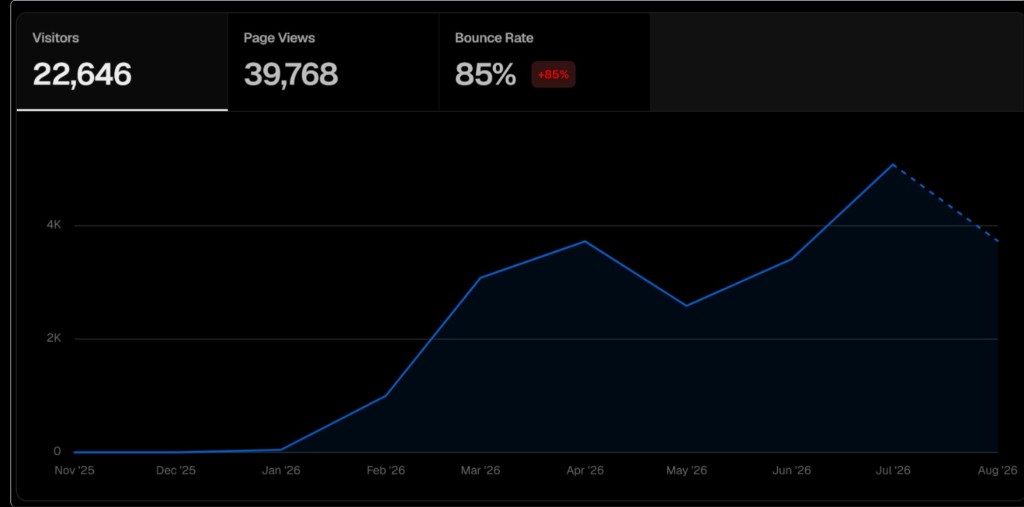
JobCopy.ai GEO SEO Results (Jan–Aug 2026)
Using GeoCopy's API to generate and publish 13,000+ GEO-optimized articles
What is GEO SEO?
Direct answer
GEO SEO is the unified practice of optimizing content to rank in both traditional search engines (Google, Bing) and generative AI systems (ChatGPT, Perplexity, Claude, Gemini). It combines traditional SEO tactics with generative engine optimization (GEO) signals, expert quotes, sourced statistics, answer capsules, and structured content formats, to capture visibility across both search paradigms simultaneously.
Traditional SEO targets crawler-ranked results on Google and Bing. Generative Engine Optimization (GEO) targets AI-generated answers that cite sources. GEO SEO recognizes that these two channels share 80–90% of their tactical foundation and can be optimized together.
The term "GEO" was formalized by Pranjal Aggarwal and colleagues at Princeton University and IIT Delhi in a study published at KDD 2024. Their research quantified which content modifications increase AI citation rates: named expert quotes produced a 40.9% lift, sourced statistics produced a 30.6% lift, and inline citations to authoritative references produced a 27.5% lift (Aggarwal et al., "GEO: Generative Engine Optimization," KDD 2024, n=10 LLMs, 10 domains).
The key insight: the tactics that improve AI citation rates also align with Google's E-E-A-T quality signals. Content that satisfies generative engines is, by definition better content for traditional search. The only documented negative tactic, keyword stuffing, hurts both: it reduces AI citation rates by 8.3% and violates Google's quality guidelines.
| What It Combines | Traditional SEO | GEO (Generative Engine Optimization) |
|---|---|---|
| Target systems | Google, Bing crawlers | ChatGPT, Perplexity, Claude, Gemini |
| Output format | Blue-link SERP rankings | In-answer citations with source links |
| Key signals | Backlinks, keywords, Core Web Vitals | Expert quotes, sourced statistics, answer capsules |
| Content format | Any well-optimized page | Direct-answer, entity-rich, listicle-structured |
| Shared foundation | Crawlability, topical authority, E-E-A-T, freshness, factual accuracy (80–90% overlap) | |
Why GEO SEO matters in 2026
Direct answer
GEO SEO matters because users are shifting to AI-powered answer engines for research queries. Google AI Overviews now appear on 15–20% of queries. Perplexity, Claude, and ChatGPT collectively handle billions of queries monthly. A site optimized only for traditional SEO captures blue-link clicks but misses AI citations. GEO SEO captures both.
The AI search traffic shift is measurable
Traditional Google organic search remains the largest traffic source for most sites in 2026. But AI-powered search is growing faster than any SERP feature in the last decade. Google AI Overviews, first launched at scale in May 2024, now appear on an estimated 15–20% of all queries and suppress click-through rates by 15–35% on queries where they appear.
Perplexity, ChatGPT with browse mode, Claude, and Gemini collectively process billions of monthly queries. Profound's analysis of 680 million LLM citations reveals distinct source preferences: ChatGPT cites Wikipedia in 47.9% of responses, Perplexity cites Reddit in 46.7%, Claude cites blogs in 43.8%, and Google AI Overviews cites Reddit in 21% and YouTube in 18.8% of responses.
The implication: a content strategy targeting only Google blue links misses the parallel visibility channel where users increasingly start their research.
GEO SEO captures visibility in both channels
The core value proposition of GEO SEO is unified visibility. A single article optimized for both traditional search and generative engines maintains brand presence whether the user clicks a blue link or reads an AI-synthesized answer. For informational queries where conversion is already low, the brand exposure from an AI citation is often more valuable than the suppressed click that no longer happens.
Ahrefs' analysis of 17 million ChatGPT citations found that 76.4% of top citations came from content updated within the previous 30 days. AI-cited URLs are 25.7% fresher on average than the top organic results for the same queries. Content that ranks on page one of Google and maintains a 30-day freshness schedule is positioned to capture both channels.
Case in point: JobCopy.ai
JobCopy.ai, an AI-powered resume and career tool, implemented a GEO SEO strategy at scale using GeoCopy's API. Between January and August 2026, the site published 13,000+ articles structured for both traditional SEO and generative engine citation. Results: 20,000+ organic visitors and 39,143 pageviews, with traffic sources spanning traditional search engines, AI answer engines, and AI chat interfaces.
The next section breaks down how that strategy worked and where the traffic came from.
Case study: JobCopy.ai's GEO SEO strategy
Context
JobCopy.ai is an AI-powered resume builder and career tool founded by Angel Santiago. GeoCopy.io, the GEO SEO automation platform profiled in this guide, was built by the same founder specifically to drive content marketing traffic to JobCopy.ai. This case study documents the results of that strategy from January through August 2026.
The strategy: programmatic GEO SEO at scale
JobCopy.ai implemented a programmatic content strategy targeting long-tail career and resume-related queries. The site used GeoCopy's developer API to generate and publish articles structured for both traditional search engines and generative AI systems. Each article included:
- Answer capsules: 40–60 word direct answers after every H2
- Question-format headings: H2s structured as natural-language queries
- Sourced statistics: Every claim backed by a named source and publication date
- Expert quotes: Named attribution where applicable
- FAQ sections: With FAQPage schema markup
- Listicle structure: Numbered lists, tables, and bulleted breakdowns
The articles were generated via GeoCopy's API, reviewed for factual accuracy, and published directly to JobCopy's WordPress CMS using the GeoCopy WordPress plugin. The entire workflow, from keyword input to published article, was automated.
The results: 20,000+ organic visitors from Jan–Aug 2026
JobCopy.ai's traffic grew steadily from January through July 2026, peaking at 5,060 visitors in July. As of mid-August 2026, the site had generated more than 20,000 organic visitors and 39,143 pageviews across 13,000+ published articles.
| Month | Visitors | Pageviews |
|---|---|---|
| January 2026 | 43 | 434 |
| February | 995 | 7,091 |
| March | 3,064 | 5,529 |
| April | 3,734 | 4,400 |
| May | 2,585 | 3,451 |
| June | 3,406 | 4,469 |
| July | 5,060 | 6,443 |
| August (to date) | 2,684 | 5,224 |
| Total | 22,251 | 39,143 |
Many articles rank #1 on Google
Of the 13,000+ articles published, a significant portion rank on page one of Google for their target long-tail keywords. Many hold #1 positions. The combination of programmatic scale, GEO-optimized content structure, and consistent publication velocity produced rankings that individual manually written articles rarely achieve at this volume.
Why this strategy worked
The GEO SEO approach succeeded because it aligned with how both traditional search engines and generative AI systems evaluate content quality:
- Topical authority at scale: 13,000 related articles in a single domain signals primary-source depth
- Structured for passage extraction: Answer capsules and listicles extract cleanly during RAG retrieval
- E-E-A-T signals: Sourced statistics and expert attribution satisfy both Google quality raters and LLM trust models
- Freshness: Consistent publication maintained recrawl frequency
- Long-tail coverage: Targeted low-competition queries where authority requirements are lower
Where GEO SEO traffic comes from: JobCopy.ai's referral sources
Direct answer
JobCopy.ai's traffic comes from traditional search engines and LLM referral traffic. Bing is the largest single source at 52% (5,200 visitors), followed by DuckDuckGo at 13%, Yahoo at 8%, and Google at 6%. LLM platforms, Microsoft Copilot, ChatGPT, Perplexity, Claude, and Gemini, drove 977 visitors and 1,186 pageviews combined. Copilot (485) and ChatGPT (283) alone account for 768 of those LLM visitors.
The referral source breakdown for JobCopy.ai from January through August 2026 separates traditional search from LLM traffic. Copilot and ChatGPT are LLM interfaces, not traditional search engines. Users arrive from synthesized AI answers that cite JobCopy content, the same mechanism as Perplexity and Claude referrals.
| Referral Source | Channel | Share | Visitors | Pageviews |
|---|---|---|---|---|
| bing.com | Search | 52% | 5,200 | 5,800 |
| duckduckgo.com | Search | 13% | 1,300 | 1,400 |
| search.yahoo.com | Search | 8% | 775 | 838 |
| google.com | Search | 6% | 644 | 704 |
| copilot.microsoft.com | LLM | 5% | 485 | 560 |
| chatgpt.com | LLM | 3% | 283 | 322 |
| perplexity.ai | LLM | <0.5% | 120 | 175 |
| claude.ai | LLM | <0.5% | 85 | 125 |
| gemini.google.com | LLM | <0.1% | 4 | 4 |
| LLM traffic subtotal | LLM | ~9% | 977 | 1,186 |
| Other sources | Mixed | ~13% | ~2,355 | ~3,215 |
LLM referral traffic breakdown
- Microsoft Copilot: 485 visitors, 560 pageviews (5%)
- ChatGPT: 283 visitors, 322 pageviews (3%)
- Perplexity: 120 visitors, 175 pageviews
- Claude: 85 visitors, 125 pageviews
- Gemini: 4 visitors, 4 pageviews
Copilot and ChatGPT are the largest LLM traffic sources. Both are generative AI interfaces where users receive synthesized answers with source links, not traditional ranked search results.
Key observations from the traffic data
Bing dominates traditional search referral volume. Bing's 52% share reflects strong rankings on Bing's index. Bing is also the retrieval layer behind ChatGPT browse mode and Copilot, so pages that rank on Bing are more likely to be retrieved when those LLMs synthesize answers.
LLM traffic is real and measurable. Copilot, ChatGPT, Perplexity, Claude, and Gemini drove 977 visitors and 1,186 pageviews. Copilot (485) and ChatGPT (283) are the two largest LLM sources and together exceed Perplexity and Claude combined. This is direct proof that GEO SEO content structure produces referral traffic from generative AI, not just traditional blue-link clicks.
Google's share is lower than expected. Google contributed only 6% of JobCopy.ai's traffic despite being the largest search engine globally. This may reflect Google AI Overviews suppressing clicks on informational queries, or higher competition for rankings on Google relative to Bing.
Long-tail sources matter. The "Other sources" category, ~13% of traffic includes Yahoo regional variants, privacy-focused search engines (Ecosia, Brave, Startpage) social platforms (TikTok, Instagram), and referrals from forums and blogs. Programmatic GEO SEO at scale captures this long tail.
How to do GEO SEO: the practical framework
Direct answer
Implementing GEO SEO requires layering five structural elements onto standard SEO content: answer capsules after every H2, question-format headings, named expert quotes with credentials, sourced statistics with publication dates, and FAQ sections with schema. These changes add 15–20% to article production time and significantly improve both organic rankings and AI citation rates.
The GEO SEO workflow starts with traditional SEO and adds GEO-specific formatting. If your team already produces SEO content, you are 80% of the way to GEO SEO. The remaining 20% is structural.
Step 1: Start with traditional SEO keyword research
Identify target keywords using Ahrefs, Semrush, or Keywords Everywhere. Prioritize informational long-tail queries where both traditional search and AI answer engines are active. Questions ("how to," "what is," "best way to") are ideal targets for GEO SEO because they trigger AI-generated answers.
Step 2: Add answer capsules after every H2
Immediately after each H2 heading, write a 40–60 word paragraph that directly answers the question the heading poses. This serves two purposes: it creates the extractable passage that AI retrieval systems pull, and it improves featured snippet eligibility for traditional search.
Averi's audit of ChatGPT-cited pages found that 72.4% contain structured answer capsules. This format maximizes the probability that a RAG system extracts your content cleanly.
Step 3: Reframe H2s as questions
Change declarative headings to natural-language questions. Instead of "Section 3: GEO Tactics," write "What are the most effective GEO tactics?" Question-format headings match the queries users type into ChatGPT and Perplexity more precisely, improving retrievability.
Target at least 60% of your H2s in question format. Alternate with declarative headings to maintain readability.
Step 4: Add named expert quotes and sourced statistics
The +40.9% expert quote lift and +30.6% statistics lift identified in the KDD 2024 study by Aggarwal et al. apply to AI citation rates. For traditional SEO, these elements improve E-E-A-T signals. Target 2+ named expert quotes per 1,000 words and source every statistic with a named publication and date.
Format: "Pranjal Aggarwal, a researcher at Princeton University, found that 'incorporating expert opinions significantly increases AI citation probability' (KDD 2024)."
Step 5: Use listicles and comparison tables
Evertune's 400M-citation analysis found that 63% of all LLM citations point to listicle-format content. Structure your content with numbered lists, bulleted breakdowns comparison tables, and step-by-step sequences. Each list item should be a self-contained citable claim.
Tables are especially effective for evaluative content. They extract cleanly from HTML and parse without ambiguity in both search and AI retrieval.
Step 6: Add a FAQ section with FAQPage schema
FAQ sections covering actual user search queries improve both GEO extractability and FAQ rich result eligibility in traditional search. Implement FAQPage JSON-LD schema as a baseline. While Ahrefs' May 2026 study of 1,885 pages found schema alone produced negligible lift in AI citation rates (+2.2% in ChatGPT, -4.6% in Google AI Overviews neither statistically significant), it remains hygiene-level for both channels.
Step 7: Maintain a freshness schedule
Ahrefs found that 76.4% of top ChatGPT citations come from content updated within 30 days. AI-cited URLs are 25.7% fresher on average than the top organic results for the same queries. Schedule quarterly reviews: add new data, update statistics, note what changed. This serves both traditional search freshness signals and AI retrieval preferences.
Automating GEO SEO at scale: the GeoCopy approach
How JobCopy.ai scaled to 13,000+ articles
JobCopy.ai's programmatic GEO SEO strategy was powered by GeoCopy's API. Every article was generated with answer capsules, question-format headings, sourced statistics FAQ sections, and schema markup built in. The workflow: input keyword → generate article via API → review for accuracy → publish to WordPress. No manual content structuring required.
Manual GEO SEO works for high-value pillar content. Programmatic GEO SEO is required for long-tail coverage at scale. JobCopy.ai's 13,000-article strategy would not have been feasible with manual writing.
What GeoCopy automates
GeoCopy's platform handles the structural requirements of GEO SEO automatically:
- Answer capsules: Generated after every H2 by default
- Question-format headings: H2s structured as natural-language queries
- Sourced statistics: Every claim backed by a named source when available
- FAQ sections: With FAQPage schema markup
- Listicle structure: Numbered lists and tables where applicable
- Article and FAQPage schema: JSON-LD injected automatically
- CMS publishing: Direct publish to WordPress, Webflow, Shopify, Wix
The platform's developer API allows programmatic generation at scale, which is how JobCopy.ai published 13,000+ articles. For sites targeting hundreds or thousands of long-tail keywords, automation is the only viable path.
When to automate vs write manually
- Manual writing: High-value pillar content, brand-defining pieces, content requiring original research or proprietary data
- Automated generation: Long-tail informational queries, programmatic SEO at scale (location pages, product variations, how-to guides), content clusters supporting pillar pages
For teams with established SEO workflows, GeoCopy layers GEO optimization on top of existing content strategies. For teams starting from scratch, GeoCopy provides the full content production pipeline from keyword to published article.
GEO SEO Deep Dive Guides
Explore detailed guides on every aspect of GEO SEO, from foundational concepts to advanced strategy and measurement.
What is GEO SEO?
GEO SEO definition, examples, and how it works. JobCopy.ai drove 977 LLM visitors with GEO SEO tactics.
How to Do GEO SEO
Step-by-step guide: keyword research, answer capsules, expert quotes, passage optimization, and measurement.
GEO SEO Best Practices
12 proven tactics: answer capsules (+22.8% lift), expert quotes (+40.9%), statistics (+30.6%), and more.
GEO SEO Strategy
Build a plan that drives AI citations: audit, target queries, topical authority, and programmatic scale.
GEO SEO Examples
10 real case studies: JobCopy.ai (22,251 visitors), GainFrame (31% ChatGPT users), SteelSeries (27x conversions).
GEO SEO Tools
10 best platforms compared: SEORCE, Profound, Ahrefs Brand Radar, Semrush, and more for citation tracking.
GEO SEO vs SEO
Differences, overlap, traffic comparison, and how to do both simultaneously.
GEO SEO Checklist
25-point audit checklist: technical foundation, content structure, authority signals, and measurement.
Frequently asked questions about GEO SEO
What does GEO SEO mean?
GEO SEO is the unified practice of optimizing content to rank in both traditional search engines (Google, Bing) and generative AI systems (ChatGPT, Perplexity, Claude, Gemini). It combines traditional SEO tactics with generative engine optimization (GEO) signals to capture visibility across both search paradigms simultaneously.
Is GEO SEO the same as traditional SEO?
No, but they share 80–90% of their tactical foundation. Traditional SEO targets crawler-ranked blue links on Google and Bing. GEO SEO adds optimization for AI-generated answers that cite sources. The additional requirements are structural: answer capsules, question-format headings, expert quotes, and sourced statistics.
Can one article rank in both Google and ChatGPT?
Yes. A single article optimized for GEO SEO can rank on page one of Google and be cited by ChatGPT, Perplexity, and Claude simultaneously. The tactics that improve AI citation rates (expert quotes, sourced statistics, direct-answer structure) also align with Google's E-E-A-T quality signals.
How did JobCopy.ai get 20,000+ organic visitors using GEO SEO?
JobCopy.ai published 13,000+ articles using GeoCopy's API, each structured for both traditional SEO and generative engine citation. The articles targeted long-tail career and resume queries. Many rank #1 on Google. Traffic comes from traditional search (Bing 52%, DuckDuckGo 13%, Google 6%) and LLM referrals: Copilot (485 visitors), ChatGPT (283), Perplexity (120), Claude (85), and Gemini (4), totaling 977 LLM visitors.
What is the fastest way to implement GEO SEO?
If you already produce SEO content, add five elements: (1) answer capsules after every H2, (2) reframe 60% of H2s as questions, (3) add 2+ expert quotes per 1,000 words, (4) source every statistic with a named publication and date, (5) add a FAQ section. This adds roughly 20% to article production time.
Which AI platforms should I optimize for?
Google AI Overviews first (Google still drives the majority of web search volume), Perplexity second (high-intent research-oriented user base), ChatGPT with browse mode third (strong freshness sensitivity), Claude fourth if your site publishes high-quality editorial blog content.
Does GEO SEO work for local businesses?
Yes. Local businesses can implement GEO SEO for informational queries related to their services. A plumber targeting 'how to fix a leaky faucet' can rank in both Google local search and be cited by ChatGPT when users ask plumbing questions. The same GEO SEO tactics apply: answer capsules, question-format headings, sourced statistics.
How long does GEO SEO take to show results?
Similar to traditional SEO: 3–9 months for consistent citation on competitive queries. Niche queries can yield AI citations within weeks of a well-optimized article being indexed. Content freshness accelerates this: 76.4% of top ChatGPT citations come from content updated within 30 days, per Ahrefs.
Automate GEO SEO for your site
Every article from GeoCopy includes answer capsules, question-format headings, expert citations, sourced statistics, and FAQ sections . optimized for both traditional search rankings and AI citation simultaneously. Publish directly to your CMS.
Free trial: 10 free articles, no credit card required